
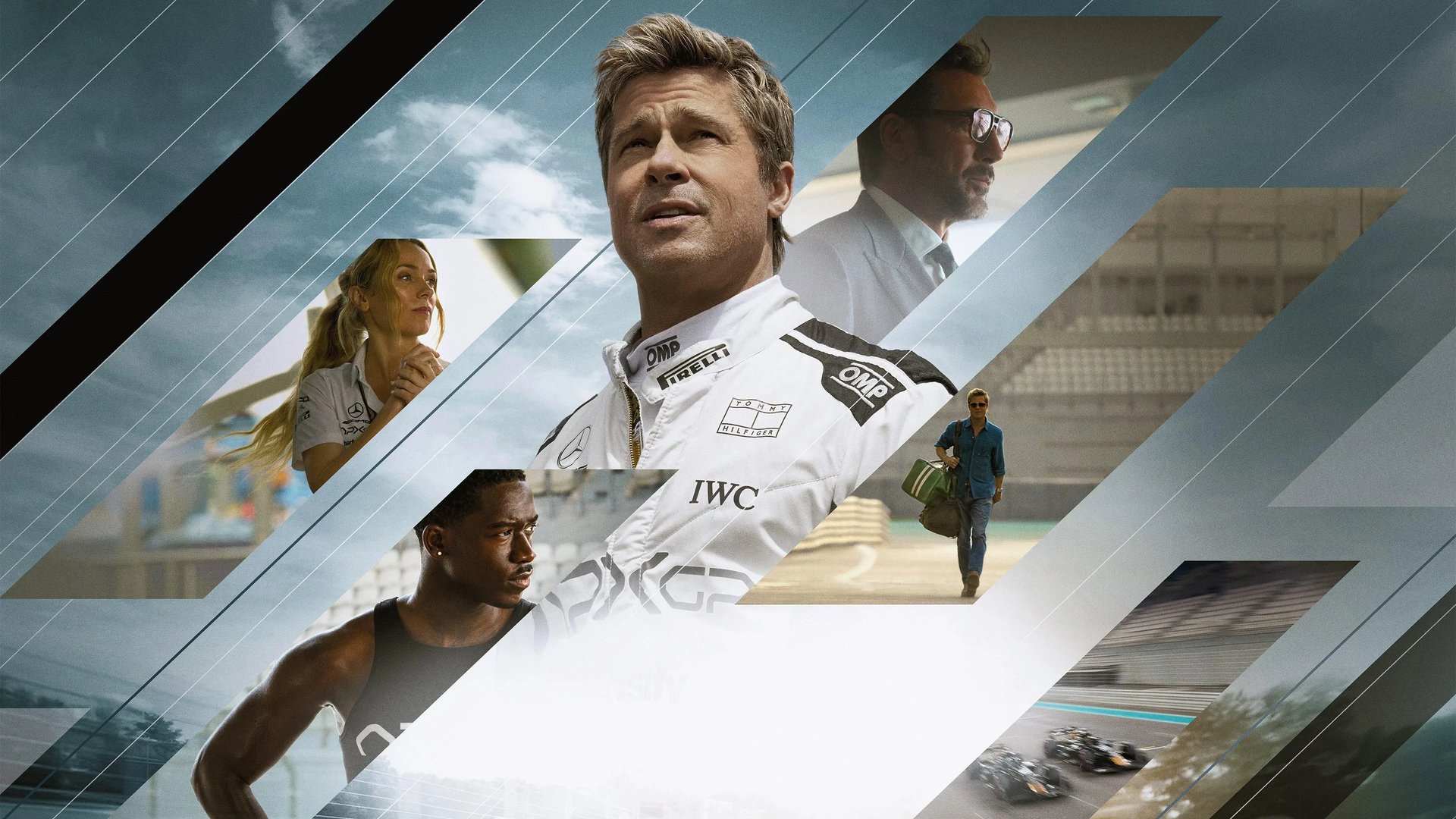
F1 The Movie (2025) | Film Review
In the end, F1 is a film that looks and sounds spectacular, but narratively it never quite makes it down the hangar straight. This is The Silver Hedgehog Full Review of the F1 Movie
FILM REVIEWACTION12A/12
Garry Llewellyn
13 min read
I really should like F1 The movie. I grew up with James Hunt and Murray Walker crackling through the TV speakers, commentary as iconic as the cars themselves.
‘’The lead car is unique, except for the one behind it which is identical.’’
Murry Walker.
I watched live as Senna tragically died in ’94. I witnessed Schumacher carve his name into history with seven world titles. I have been entertained by larger than life characters such as Eddie Jordan, and I cheered for the underdog when Brawn GP somehow won the Constructors’ Championship. I have even watched as Liberty Media have ‘’reinvigorated’’ the Sport.
Yet the F1 movie is not a film I raced to the Cinema to watch, how very Verstappen of me! I finally caught up with the film, when the F1 movie landed on Apple TV+
The production team behind Top Gun Maverick are driving the F1 movie to the Chequered flag. Has writer Ehren Kruger pulled off the pass of the century, or has he stalled at the pit exit? Let’s find out.
At its heart, the F1 movie is an underdog story. A struggling back of the grid team F1 team APX GP are fighting for survival.
Oh, to have been in the writers’ room for that one. “We need a generic team name that screams Formula 1 but carries absolutely no sense of heritage, strength, or branding.” “What’s that thing drivers aim for in corners?” “The apex?” “Perfect. Remove the E, make it edgy. APX GP. Nailed it.”
The team is on the brink of being sold by the board, and with nine races left in the season, desperation is setting in. Enter team manager Ruben Cervantes (Javier Bardem), who decides the best way to save the team is to drag a washed up, gambling, seen better days driver back into the cockpit: Sonny Hayes.
Kruger is not messing around with how American he wants this story to feel. If Scott Speed wasn’t already a real F1 driver, I get the sense he’d have been first on the character name shortlist.
Predictably, Brad Pitt’s Sonny Hayes agrees to the comeback, and this sets up the classic “older veteran vs. young hot‑headed underdog” dynamic. It’s a trope as old as motorsport cinema itself. The problem is the film leans into it with such conviction that it loses any real sense of what Formula 1 actually is.
Where’s the passion?
Where are the fans?
Every team in F1 has a fiercely loyal following entire grandstands of colour, chants, flags, and heartbreak. The F1 community lives for an underdog story, yet none of that energy makes it to the screen. The closest we get, is the occasional half‑second crowd shot, as if someone remembered at the last minute that races do, in fact, have spectators.
And where is the inter‑team rivalry?
In one scene we get a trash‑talk press conference between McLaren, Ferrari, and APX GP, but it feels like an afterthought; a contractual obligation to acknowledge that F1 teams occasionally snipe at each other. It’s surface‑level drama, the cinematic equivalent of ticking a box labelled “banter”.
As the story continues, we do get flashes of genuine Formula 1 DNA. Pit crews botching stops (introducing a sub plot that leads nowhere,) drivers playing tactical games, radio messages dripping with tension all the little details that make F1 such a beautifully chaotic sport.
But the way these moments are written often feels forced, as if the script is ticking off a checklist labelled “F1 Things Fans Will Recognise” rather than letting the drama emerge naturally. Instead of weaving these elements into the story’s fabric, the film drops them in like cameo appearances. For example, Apx’s second driver Joshua Pearce, played by Damson Idris has an accident that appears to be inspired by Niki Lauda’s 1976 Nürburgring fireball, and by Romain Grosjean’s 2020 Bahrain inferno.
The annoying thing is the script never capitalises on this moment. It’s another example of the film borrowing iconic F1 moments without understanding the mindset behind them. Just when I thought, “Ooooh, they’re referencing Niki Lauda here we go, proper F1 incoming,” the film swerves straight into Hollywood fantasy. Pearce is in no ‘Rush’ to get back into the cockpit.
*sorry couldn’t resist that one!
He sits out, broods, contemplates life, as if he’s a character in a Harlan Coben drama, rather than a Formula 1 driver with adrenaline for blood. Any real F1 driver in that scenario would be clawing their way back into the car the moment the bandages stopped smoking. Look at Lance Stroll, the man breaks both wrists and is back racing within weeks, still taped together like an action hero. That’s the mentality, that’s the sport, that’s the obsession.
As the underdog story moves forward, the screenplay goes from bad to worse, turning the F1 races into a stylised caricature of themselves. Our protagonist decides he’s a driver who takes no prisoners, fighting for every corner and every overtake, nothing wrong with that in fact, that’s the one part that does resemble real Formula 1. The problem is that Sonny’s comeback arc quickly spirals into behaviour no real driver in the paddock would ever get away with. He fakes stalled starts, deliberately crashes into rivals, and causes outright carnage, just to engineer an advantage for the team’s number two driver.
In the real world, he’d be black‑flagged, hauled in front of the stewards, and handed a race ban before he even made it back to the garage. Case in point ‘Crashgate’ Nelson Piquet Jr. (2008 Singapore GP) - it was a team‑ordered crash. It led to bans, resignations, and years of fallout. This wasn’t “cheeky race craft” it was one of the darkest moments in F1 history. Does the film fictionalise F1 too far? Yes absolutely. This isn’t gritty racing or clever strategy; it’s cartoonish sabotage that belongs in a mid‑90s action movie, not a film claiming to represent the pinnacle of motorsport.
I get that the F1 Movie is not a factual documentary of the sport, in fact it’s a love story, wrapped up in an F1 branding, but if you are using F1 as the name of your film and make noise about how realistic the film is and have a world champion producer (Hamilton) I expect more, I also expected more from Kruger. That’s the real frustration: this could have been a completely different, far more engaging story. Formula 1 has over seven decades of real‑world controversy, politics, and high‑stakes drama the kind of material screenwriters dream of. Instead of inventing a flimsy underdog story with a love subplot and a manufactured rivalry, the film could have drawn from the sport’s own history.
F1 has seen everything from the infamous “white powder” paddock incident, to McLaren allegedly copying Ferrari’s data, to long‑standing suspicions that Schumacher’s Benetton was running illegal driver‑assist systems. These are the kinds of stories that already feel cinematic, tense, political, morally grey, and rooted in the sport’s culture. Any one of them could have inspired a richer, more authentic narrative than the American view of a European sport we get.
F1 doesn’t need embellishment, it needs explanation, the screenplay had the chance to be a podium finisher, but somewhere in the drafting process, it locked up, ran wide, and rejoined in the midfield. As every F1 fan knows, the middle of the road is not a great place to be.
F1 The Movie Casting
Here is my pick of 3 cast Members
Brad Pitt as Sonny Hayes.
There is one major disconnect between the character of Sonny Hayes and the actor playing him: age. The film asks us to believe he’s returning to Formula 1 after 30 years away, which puts him somewhere around 55–60 years old conveniently matching Brad Pitt’s real age. But there is simply no universe in which that would ever happen in F1.
Michael Schumacher, one of the fittest and most successful drivers in the history of the sport, returned at 41, and even that was considered pushing the limits of what the human body can endure in a modern F1 car. Alonso at 44 is treated like a medical miracle. Most drivers are done by their late 30s.
So, asking the audience to accept a 60‑year‑old Sonny Hayes making a competitive comeback isn’t just unrealistic it’s pure Hollywood fantasy, and the problem is, the F1 movie isn’t branded as a fantasy. It wants the authenticity of real Formula 1 but then builds its central character around something the sport would never, ever allow.
However unrealistic the character may be, Pitt is undeniably committed to Sonny Hayes and goes full‑throttle into the character. You can see the graft he’s put in. There’s footage of him training with McLaren, learning the cockpit discipline, the hand movements, the posture all the tiny details that make an F1 driver look like an F1 driver. It’s a very method approach, and to his credit, Pitt sells the physicality far better than the script around him deserves.
What really helps Pitt is his natural charisma. Pitt enables Sonny Hayes to feel like someone who genuinely could have been a legend in his day. Even when the story stretches credibility to breaking point, Pitt grounds the character with a kind of lived‑in authenticity. He looks like a man who’s been through the wars, made mistakes, and still has something left to prove. It’s just a shame Pitt is left with dialogue that says things like:
“I’m not here to be a hero. I’m here because I don’t know how to be anything else.”
And
“I’ve buried teammates, rivals, and a version of myself I’m still trying to outrun.”
Tobias Menzies as Peter Banning,
About halfway through its epic two‑and‑a‑half‑hour runtime, Peter Banning suddenly appears and I genuinely have no idea why. Up to that point, we’re told that “the Board” wants results and is considering selling APX. That’s perfectly serviceable background tension; we don’t need to meet the board, we don’t need a face for the threat, and the film seems content to leave it as an off‑screen pressure.
Then Banning arrives out of nowhere as a board‑member villain, and the whole thing feels like a studio meddling brought awkwardly to life. It’s a shoddy introduction and an even worse written character. Instead of adding depth or political intrigue, he derails the pacing and reduces the boardroom tension to a cartoonish, one‑note antagonist. Tobias Menzies tries to play Peter Banning as this icy, tough, corporate hard‑man. But the performance is constantly fighting against the writing. Instead of coming across as a steely operator, he ends up feeling like a bit of a weasel: petty, snide, and strangely small for someone supposedly wielding so much power.
The result is a character who isn’t intimidating, isn’t believable, and certainly isn’t worthy of the threat the film wants him to represent. Real F1 boardroom sharks are strategic, ruthless, and terrifyingly competent. Banning feels like a man who’s wandered in from a mid‑tier office drama, trying to act tough but never convincing anyone, least of all the audience
Kerry Condon plays Elena,
Our editor JJ spent the entire film thinking Rebecca Ferguson was putting on an Irish accent, only to realise three hours later that it was actually Kerry Condon!
Condon, fires off technical jargon with total conviction, moving through the garage with the confidence of someone who’s lived in wind tunnels and data rooms for decades.
Condon delivers every line with a real sense of believability sounding like someone who genuinely wants the team and the drivers to push forward. There’s intent behind her words, you feel the urgency, the frustration, the pride. She plays Elena as a leader who cares deeply about the people around her, not just the machinery.
One of the film’s flaws is the way it handles Kerry Condon’s character. The script can’t resist saddling her with a love‑interest subplot. It’s not just unnecessary; it actively weakens the character. She’s already the smartest person in the garage, already the emotional anchor of the team, already delivering the most grounded, believable performance in the film, she doesn’t need a romance to be interesting.
The film defaults to the old Hollywood idea that the main female character must also be the emotional subplot, as if the writers couldn’t imagine a woman in F1 leadership, without softening her edges, or tethering her to a male character.
The writing’s lack of imagination stands out precisely because through Condon ‘s portrayal we see glimpses of what the character could have been, if the writers had belief in their subject.

F1 The Movie Sound
The film’s sound work is shaped by a team working closely with Hans Zimmer, who wasn’t just composing he was deeply involved in the overall sound design. Apple’s behind‑the‑scenes features emphasise that sound was treated as “paramount” to the experience, aiming to put the audience inside the car, and that philosophy pays off. The Dolby Atmos mix is incredible, with cars whipping around the soundscape and just the right amount of low‑end rumble to make every acceleration feel physical. Speech is pin‑sharp, the music beds sit perfectly in the mix, and the whole track feels meticulously engineered. Engine texture feels lifted straight from trackside microphones; ERS whine, turbo spool, tyre scrub, kerb strikes all present, all accurate. It’s one of the few areas where the film doesn’t just imitate Formula 1 it genuinely feels like it.
I have one question, though… where is Brian Tyler? Each weekend during the season we hear Tyler’s big, orchestral F1 theme the musical identity of modern Formula 1. You’d think the licence owners would want that brand recognition in their flagship movie, yet it’s strangely absent. Instead, we’re treated to Hans Zimmer, who spent race weekends grinning like a Cheshire cat as he worked out how to ensure his score emphasised the natural soundtrack of a Grand Prix. A tactic he deployed on Maverick. He is a great choice, but it does make the omission of Tyler’s iconic theme feel all the more noticeable.
It's said that Lewis Hamilton pushed for a score that captured the human side of racing, not just the spectacle. So Zimmer leans into swelling strings, rising motifs, and moments of introspective calm between the chaos and its perfect.
Continuing the attempt at immersion, Hamilton asked that UK commentators David Croft (Crofty) and Martin Brundle make an appearance. At first, it’s a genuine great to hear them their voices instantly add a layer of authenticity that no Hollywood actor could replicate. But the novelty wears off quickly. The commentary they provide becomes oddly over‑explained, focusing almost exclusively on APX Racing as if the rest of the grid barely exists. Instead of sounding like a real broadcast team reacting to a live Grand Prix, they’re delivering scripted exposition designed to steer the audience through the plot. It’s enthusiastic, but it’s also strangely artificial, and it breaks the illusion the film is so desperate to maintain.
Effects
The film really benefits from good visual effects as the effects team really kept everything in the sweet spot. The production uses real circuits, real track time, and real cars, with APX GP’s cars built from modified Formula 2 chassis, wrapped in bespoke bodywork to look like an F1 car. Special camera rigs including miniaturised IMAX‑certified units were developed to mount inside cockpits and on bodywork, more on that below. This gives the racing sequences a physicality that CGI alone could never achieve. VFX still plays a major role. Digital crowd extensions, signage replacements, and continuity fixes help stitch together footage shot across multiple race weekends. Some overtakes and crashes rely on CGI enhancements and sadly the illusion cracks whenever the script demands physics‑defying chaos.
APX GP’s race suits and pit‑crew gear were created using real FIA‑spec materials, with manufacturers like OMP involved to ensure the stitching, fit, and fire‑retardant look matched modern F1 standards. Helmets were designed with input from Lewis Hamilton, giving them the correct aerodynamic shapes, vents, and visor profiles. Even the pit‑crew choreography was coached by actual F1 mechanics, right down to the gloves, boots, and radio setups.
Great job to those involved.
F1 The Movie Video Quality
F1 is a film engineered from the ground up to look spectacular, and the video presentation reflects that ambition. Shot by Claudio Miranda ASC, ACC, Joseph Kosinski’s long‑time cinematographer and an Oscar‑winning DP the film uses a combination of Sony CineAlta Venice 2, Venice Rialto Mini, DJI Ronin 4D, RED Komodo, and even iPhone 15 Pro Max cameras for certain inserts. Miranda and Kosinski worked closely with Sony to develop customised camera solutions small enough to mount on real race cars while still delivering IMAX‑worthy image quality. I wonder if this technology has infused the TV broadcast?
This hybrid cinematography approach is designed to capture speed, vibration, and cockpit intensity with unprecedented clarity. The result is a 4K image that feels alive crisp, dynamic, and bursting with detail exactly the kind of immersive visual experience you’d expect from the DP behind Top Gun: Maverick and Life of Pi.
The colour palate opts for a grounded, documentary style look Cool tones in garages, warm, sun‑kissed trackside exteriors, accurate skin tones even, under harsh lighting.
IMAX screenings accounted for 23% of the film’s North American opening weekend and 19% of its global debut, contributing $85 million to its worldwide gross, a sign of how central the format is to the film’s identity. However IMAX feels like overengineering as the film has predictably landed on Apple TV + and as of yet the Apple platform shows no signs of presenting content in IMAX Enhanced format.
Overall thoughts
For a sport famous for its larger‑than‑life characters, the script somehow manages to flatten them. Instead of the sharp wit of Eddie Jordan, the volcanic vocabulary of Guenther Steiner, or the philosophical intensity of Senna, we get cardboard cut‑outs delivering dialogue that feels pre‑approved by a marketing department. If Drive to Survive had a movie, this would be it.
It takes a beautifully over‑engineered European sport a place where men in fireproof underwear debate tyre compounds like philosophers and turns it into a two‑hour fever dream. It’s Formula One rewritten by someone who thinks Eau Rouge is a perfume and the Nürburgring is a type of burger.
What keeps the film from completely spinning into the gravel the circuit is the craftsmanship behind it. The visuals, the effects work, and the sound design are all delivered with genuine passion and technical precision. The production team clearly understood the assignment, even if the script didn’t.
In the end, F1 is a film that looks and sounds spectacular, but narratively it never quite makes it down the hangar straight. An entertaining watch, just not the champion it could have been.
The Silver Hedgehog Rating: 3.8 'Average'
The Script / Screenplay
🦔🦔
Casting
🦔🦔🦔
Effects Quality
🦔🦔🦔🦔🦔
Sound
🦔🦔🦔🦔
Video
🦔🦔🦔🦔🦔
In the end, F1 is a film that looks and sounds spectacular, but narratively it never quite makes it down the hangar straight.
Words Garry
Editor JJ
Images The Movie Database
Want to comment?
If you’ve enjoyed the latest review and our usual burst of creative chaos, swing by our Facebook page and drop us a comment. We love hearing what you think, and your thoughts help shape the next wave of movies, series, and mayhem we dive into.
About Garry
I’ve been writing in‑depth reviews since 2020 and I’m a proud supporter of independent cinema. I’m a lifelong Sci‑Fi fan, and I probably spend far too much time photographing anything that catches my eye.

You might like our other Film Reviews.


Support our website with a coffee.


About The Silver Hedgehog
The Silver Hedgehog is a review website dedicated to providing in-depth reviews. We aim to review a wide variety of Films, Entertainment, Family Days Out and Special Features.
As an Amazon Associate I earn from qualifying purchases.
Indie Filmmakers, Publicists and Small Business Owners
Indie filmmakers, publicists, creatives, and Small Business owners interested in coverage
please email screeners or inquiries to submissions@thesilverhedgehog.com
©️Garry Llewellyn 2020-2026 All text is the property of Garry Llewellyn and TheSilverHedgehog.com.
Text should not be reproduced in whole, or in part, without permission from the author.
All images, unless otherwise noted, are the property of their respective copyright owners.